
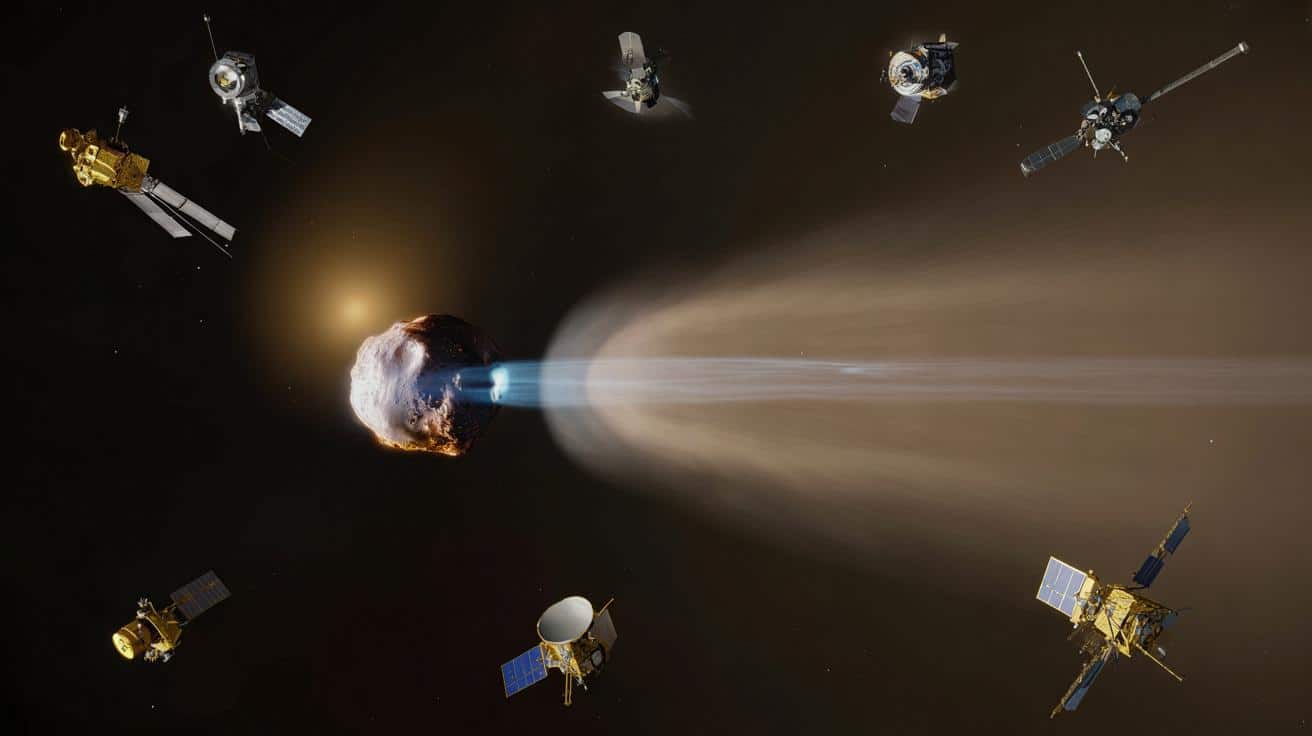
Eight different spacecraft have just dropped fresh looks at 3I/ATLAS, an interstellar comet slicing through our neighbourhood. The shots aren’t glossy posters. They’re raw, clever, stitched glimpses from wildly different vantage points — the kind that change what we think we know.
A thumbnail from a solar observatory pops into view, grainy and a little stubborn, the comet a smudge nudging past crowded stars. Minutes later, an Earth‑orbiting telescope publishes a crisp monochrome cutout. Then a deep‑space probe, far beyond Neptune, shares a whisper‑thin line where the coma should be fat. You can feel the room lean in, the way you do when a train appears at the end of a tunnel and you’re not sure which track it’s on. We zoom, we stack, we blink. The comet seems to breathe between frames. It’s a small shock. Eight separate spacecraft saw the same visitor from eight utterly different skies.
Eight eyes on a wanderer
What strikes first is the geometry. From low Earth orbit, the core of 3I/ATLAS sits as a bright pin, its surrounding haze flattened by city‑light gradients of the Milky Way. From a Sun‑skimming craft, the coma stretches into a pencil‑thin tail, like spun glass caught in a breeze. The Mars‑side angle is almost sideways, and you get parallax in your bones. It’s the same comet, the same moment, but the world beneath each camera is completely different.
One image from Hubble reads like a technical drawing, the nucleus tucked inside a soft, round halo. JWST paints in thermal contrast: a warm nudge where ices shed, a cooler skirt where dust drifts. SOHO and STEREO‑A lay out the long game, showing the tail agree with the solar wind as if nodding to a traffic warden. New Horizons, absurdly far, delivers a faint but clean recording that feels like listening to a song through a wall, and still recognising the tune.
Put them together and the maths becomes music. Triangulation from widely spaced platforms tightens the path and speed, and the hyperbolic arc stops being a theoretical sketch and starts being a road you can trace with your finger. The tail’s bend, different in each frame, maps the wind that streams from the Sun. Where a single telescope would guess, eight instruments compare notes. No one image tells the story; the mosaic does.
What the images are whispering
Early reductions lean toward a comet that woke up far from the Sun. That means super‑volatile ices — CO or CO2 — turning into gas at distances where water would still sleep. In the solar observatory frames, a slender, feature‑first tail appears before the classic dust fan. That sequence matters. It hints at chemistry that formed under a different star, in a colder nursery than ours. Early reductions point to a comet waking up far from the Sun, hinting at super‑volatile ices.
There’s also a rhythm in the jets. Short stacks from JWST show brightness pulsing, not wildly, but with a patience that suggests a slow roll. That could be a long rotation, or a nucleus that’s tumbling, its vents facing the light on a schedule we’re just starting to clock. We’ve all had that moment when the ceiling fan makes a shadow flicker and you catch the pattern only after staring too long — the comet gives that same vibe, and it’s weirdly human to watch.
Dust tells its own truth. Hubble’s visible frames favour fine grains; the deep‑space probe’s distant view, stripped of glare, keeps the coarser stuff. Together they sketch a narrow size distribution that isn’t typical of many local comets. It’s not a rule breaker, just a quiet oddity. If that holds, it means 3I/ATLAS formed in a disk where gentle collisions dominated, not grinding smash‑ups. *This is what the first true portraits of an interstellar wanderer feel like.*
How to read these pictures like a pro (without being one)
Start with the edges. Real detail lives where the coma fades into black. Blink between two frames from different spacecraft and watch what stays put and what slides. Stars that don’t budge are background; the comet shifts, and the tail leans. That lean is a windsock. Stack three frames and the jets become threads. Draw a line through a jet and you’re already guessing the spin.
Then go hunting for the faint. Noise isn’t your enemy; randomness is. Grain that dances the same way in every image is probably structure. Grain that jumps around is just your eyes begging for a pattern. Let the images breathe on your screen. Zoom out. Zoom in. And if you catch yourself chasing ghosts, stand up, drink water, and start again. Let’s be honest: nobody actually does this every day.
People trip most on colour. Instrument palettes aren’t literal; they’re maps of energy. A red smear in a JWST composite might be warmth, not rust. A blue tail in a SOHO field might be a filter speaking, not a gas cloud being coy. Don’t fight the legend; read it like a weather chart you only half remember from school.
“What you’re seeing is a chorus, not a solo. Eight instruments sing in eight keys, and our job is to catch the harmony,” says one mission scientist, sounding more like a music teacher than an engineer — and that’s perfect.
- Look for parallax: images taken from far‑flung craft will disagree on background star positions. That’s good.
- Watch the tail angle: shifts over days map the solar wind like time‑lapse smoke.
- Track the pulse: repeating bright spots in stacked frames hint at rotation or tumbling.
What we’ve learned — and what it could mean for us
The headline lesson is strangely comforting: coordination beats brilliance. With eight sets of eyes, we get confidence rather than drama. The interstellar label for 3I/ATLAS isn’t a stylist’s flourish; the hyperbolic path, the speed, and the distant awakening all lean the same way. That’s how science should feel — not a single mic‑drop, but a roomful of nods. And yet, tucked inside those nods are surprises that keep the coffee hot. A coma lighting up in the cold. Jets that don’t match our quick‑and‑dirty models. Dust that falls narrower than we guessed. It’s enough to make you text a friend at midnight and send a blurry screenshot anyway. The first time an interstellar object popped by, it was a cigar‑shaped puzzle with no tail. The second was a classic snowball with a wild backstory. This third one, if the trends hold, may be a careful teacher. It asks us to slow down and listen.
| Point clé | Détail | Intérêt pour le lecteur |
|---|---|---|
| Multi‑vantage imaging | Eight spacecraft — including Hubble, JWST, SOHO, STEREO‑A, Solar Orbiter, Parker Solar Probe, New Horizons, and BepiColombo — captured 3I/ATLAS from vastly different angles. | Shows how parallax and diverse wavelengths turn blurry hints into a reliable picture. |
| Early activity far out | Images suggest the comet “switched on” in deep cold, consistent with CO/CO2 ices driving the first jets. | Signals a birthplace under another star’s faint sun, and a chemistry we rarely see up close. |
| Tail and jet behaviour | Tail angles trace the solar wind; pulsing jets hint at slow rotation or gentle tumbling. | Makes the images feel alive and gives you a handle to spot patterns yourself. |
FAQ :
- Is 3I/ATLAS really interstellar?Current trajectory fits, shared across the eight datasets, point to a clearly hyperbolic path and high incoming speed. That’s the classic fingerprint. Teams will keep refining the numbers as more images land.
- Why do different spacecraft images look so different?Each instrument works at different wavelengths and from different vantage points. One might be sensitive to warm dust, another to gas, another to sunlight scattered by fine grains. The mix is the magic.
- Where did 3I/ATLAS come from?The sky‑path suggests a distant origin outside the Solar System, not tied to any known local family. Pinning a source star is a long shot; the Galaxy stirs slow and wide, and tiny nudges add up over millions of years.
- Can I see it from my back garden?Maybe, if it brightens and you have dark skies. Many of the images you’re seeing are long exposures on exquisitely stable platforms. Keep an eye on observing guides — and don’t be shy about binoculars.
- What’s the single biggest takeaway from these images?Confidence. Multiple vantage points agree on motion and behaviour. Surprises remain, and that’s half the joy, but the bones of the story are firm enough to lean on.







Mind blown that New Horizons caught a faint, clean trace while SOHO/STEREO see a glass‑thin tail from inside. This is exactly why eight vantage points beat one giant mirror. The parallax is the headline for me—definately changed my mental picture.
How confident are we that the early “switch‑on” isn’t reduction bias? Cross‑mission calibratoin drifts, different bandpasses, different PSFs—seems risky to declare CO/CO2 so soon. Show the multi‑instrument fits?