
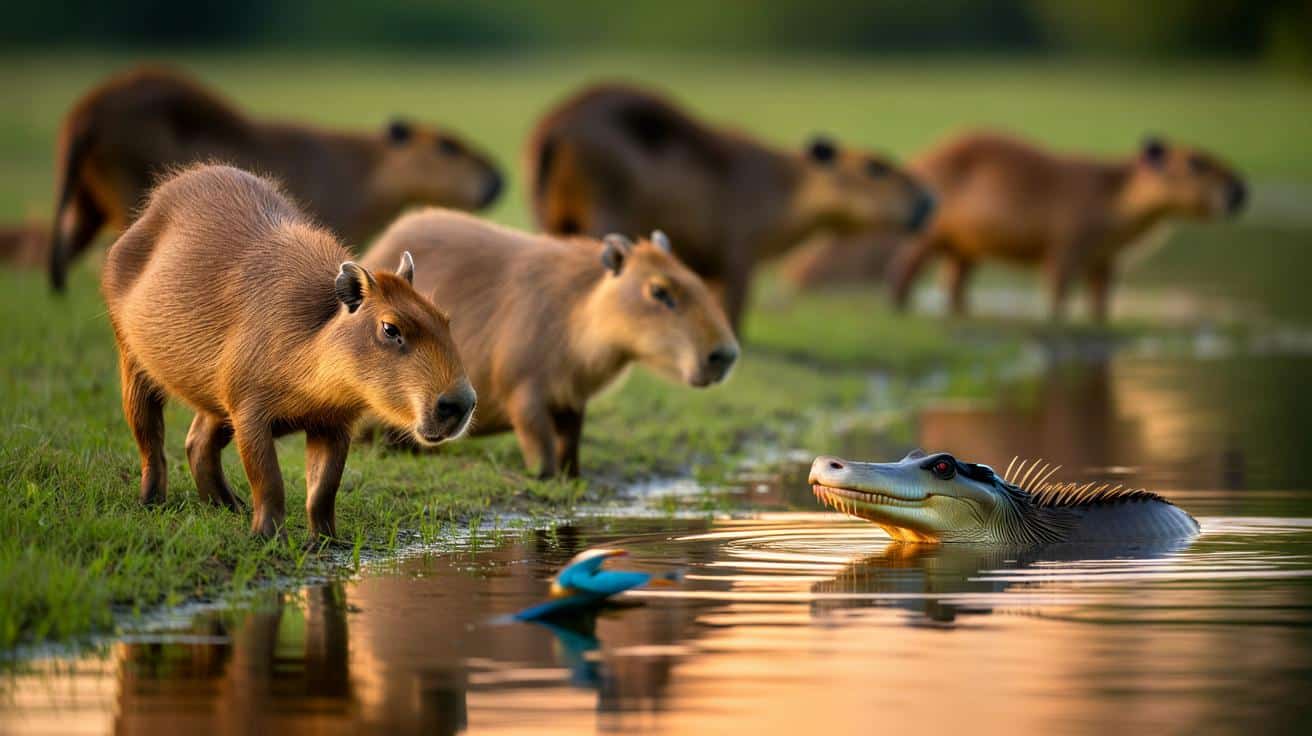
Teeth, fur, calm water. Why doesn’t the lizard of your nightmares just… eat the world’s chillest rodent?
Late light spilled gold across a Pantanal oxbow when I first saw the pairing for real. A herd of capybaras grazed the bank, ears flicking, while a broad-backed caiman lay half-submerged, eyes like polished stones. I expected a splash, a scramble, the bit you can’t unsee. Instead, nothing happened. The capybaras chewed, the caiman blinked, a kingfisher stitched the air with blue. I felt the strange hush of a place that knows its rules better than we do. *I held my breath.* No panic.
The quiet truce on South American riverbanks
Here’s the unglamorous truth biologists keep repeating: it rarely pays. Adult capybaras are hefty—35 to 70 kilos—and far from helpless, while a crocodilian runs on a strict energy budget. Predators make a cold calculation, and **risk versus reward** often tells them to pick fish, crabs or a smaller mammal.
Field notes from the Pantanal and Llanos say the same in dry ink. Spectacled caimans eat mostly fish by volume in many sites, often well over 70% across seasons, with mammal remains turning up as a minority. One researcher I followed, paddling a low canoe at dusk, counted eight capybaras within ten metres of a basking caiman. She scribbled one word: “tolerance”. The caiman didn’t move.
There’s mechanics in the mix too. A big adult capybara can inflict a nasty bite with chisel incisors, and a struggle risks injury to a reptile that relies on being whole. Group living tilts the odds further: capybaras post sentinels, bark alarms, and bolt in a staccato rush that triggers **predator confusion**. The maths of **optimal foraging** favours what’s easy, abundant, and safe.
How capybaras manage the danger
Watch their choreography. Capybaras keep the water as an escape hatch, grazing with a quick line to the reeds or a plunge pool. They sprint up to around 35 km/h on land, dive for minutes in silt-dark water, and reappear with just nostrils showing. Two steps, then a chew, then a glance: micro-pauses that map the bank.
People get the story wrong by assuming friendship. It’s not that. It’s rule-following across species, refined by long seasons. The capybaras avoid pups near the jaws, keep distances, and never turn their backs for long. Let’s be honest: nobody does that every day. Yet they manage it hour by hour, because the cost of relaxing is higher than the cost of being a little tense.
“A healthy adult capybara presents poor value for a crocodilian most days,” a herpetologist told me by the boat ramp, tapping a mud-slick boot. “Fish don’t kick back.”
Predators aren’t brave; they’re economical. The surprise is not mercy, it’s arithmetic.
- Capybara strategy: stay social, keep water close, rotate sentinels.
- Crocodilian strategy: conserve energy, hit what’s small, injured, or distracted.
- Seasonal twist: dry months compress wildlife at shrinking pools, and risk climbs.
What scientists think is really going on
Predator–prey theory gives the scaffold. Crocodilians are ectotherms, so every chase steals warmth they must reclaim from the sun. A burst at the wrong target wastes hours of basking and days of reserves. That’s a brutal economy, and capybaras exploit it by being large, alert, and near deep exits.
There’s also an indirect bargain knotted into the water. Capybaras defecate in rivers and ponds, which fertilises fish nurseries. Many caimans feed largely on those fish. More fish means fewer reasons to gamble on a 60-kilo mammal with scar-making teeth. The coexistence isn’t a handshake; it’s a nutrient loop making peace the cheaper option.
Cameras trap the nuance. Adults often share sandbanks at a calm distance. Young capybaras still vanish on bad days, especially when drought pins everything to the same shrinking lagoon. No myth of harmony survives the dry season entirely, though the baseline is tolerance. The headline isn’t “never”. It’s “mostly not worth it”.
Fieldcraft from animals, for humans
Copy the capybaras if you ever watch this dance. Pick a vantage with cover and a clean line out, then settle into stillness. Scan in loops—water, bank, herd, sky—so you catch the flick of an ear or the ripple that matters. Two slow breaths per glance. Then wait.
Common errors start with crowding a bank or breaking silhouettes. Kneel instead of standing, speak softly, and avoid reflective kit that flashes like a lure. Photographers push their luck for the shot and spook the scene into chaos. I get it. We’ve all had that moment where patience runs out and the feet move on their own.
My notebook has a single phrase starred three times: respect the threshold.
“If the capybaras stop chewing, you’re already too close,” said a Pantanal guide who has counted more caimans than most of us have counted buses.
- Best light: first and last hour of day; the animals are calmer, the water speaks.
- Tell-tale stress: stiff necks, head-up freezes, sudden synchronized silence.
- Back off signal: one alarm bark followed by a collective pivot toward the water.
The story that keeps rewriting itself
Look long enough and the riverbank stops being a meme and turns into a ledger of costs. A crocodilian learns the weight of a meal, the pain of a mistake, the price of a sprint under a cool sky. A capybara learns distances, shadows, and the simple power of staying in numbers.
Some years the ledger is kind. Fish are fat, rains came right, and the truce holds. Other years tighten like a belt, and the calculus shifts with the mud. Predation happens, nerves fray, and the memes don’t tell that part. Stories do, and the bank has plenty.
So the question “why don’t crocodiles eat capybaras?” becomes a more interesting one: when do they decide not to. If that feels unromantic, fair enough. It’s also the thread that stitches science to what your eyes already see on the water—an uneasy peace, priced daily, paid in full.
| Point clé | Détail | Intérêt pour le lecteur |
|---|---|---|
| Energy maths | Ectotherms conserve energy and choose low-risk, high-yield prey | Explains the calm scenes without invoking myth or magic |
| Capybara tactics | Group vigilance, water as escape, size and speed | Decodes the behaviour you can spot in seconds |
| Seasonal switch | Dry-season crowding raises predation pressure | Sets expectations for when the truce can fray |
FAQ :
- Do crocodiles ever eat capybaras?Yes. Juveniles are most vulnerable, and tough seasons push predators toward riskier targets. The viral calm is real, just not universal.
- Which crocodilians live with capybaras?Mainly spectacled caimans across much of their range, plus yacaré caimans in the Pantanal and, in parts of the Orinoco basin, the Orinoco crocodile.
- Why do we see them sitting side by side?Shared habitat, overlapping sunbathing and grazing windows, and a learned tolerance at safe distances. Sun is a limited resource for reptiles; sandbanks become crowded.
- Are adult capybaras safe from attack?Safer, not safe. Their size, teeth and group alarms lower the odds, especially when fish are abundant. Edge cases still happen.
- Is there any benefit to crocodilians from capybaras?Indirectly, yes. Capybaras fertilise waters where fish grow, and many caimans rely largely on fish. More fish, fewer risky chases.








Loved the « predators aren’t brave; they’re economical » line. Thanks for breaking down risk vs reward, optimal foraging, and the nutrient loop — never knew capybara poop could tip the fish supply. Makes the calm scenes make sense at last 🙂