
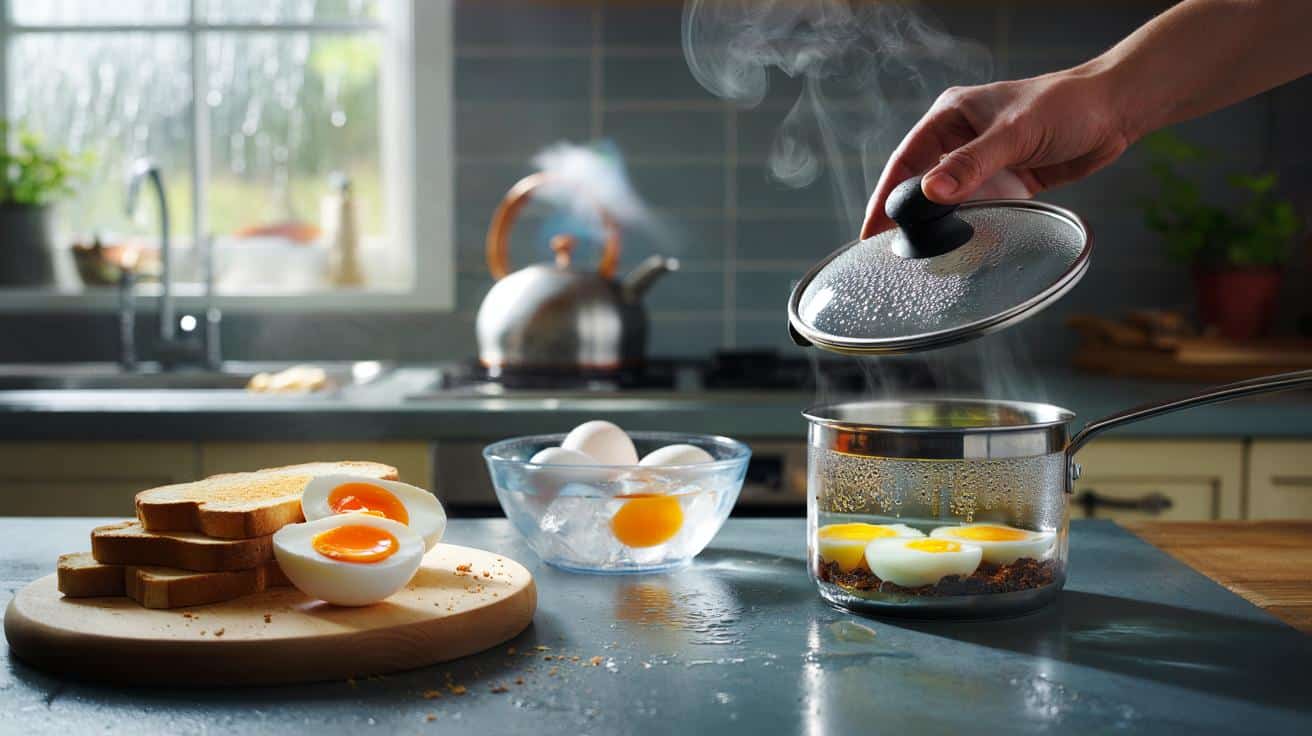
And still, the yolks swing from gummy to chalky with the reliability of British sunshine. There’s a calmer way to get eggs right, every single time. It uses less water, fewer nerves, and gives you that rich golden centre you picture in your head. The best part? It doesn’t involve a pot sloshing on the hob at all. Once you switch, the wobble in your morning vanishes with the steam.
The kitchen was quiet apart from a kettle rumbling to life. No clatter of lids, no pan brimming to the edge. On a rainy Tuesday, I watched a friend balance six eggs in a small steamer rack, mist curling up like breath on glass. We chatted. The timer blinked toward nine and he didn’t hover. He lifted the lid, dropped the eggs into a bowl of cold water, and handed me one. Peel, slice, stare: deep amber, glossy, jammy. The soldiers practically saluted. The saucepan never came out.
Why steaming beats boiling for eggs
Call it sacrilege or call it progress, but **Steam, don’t boil**. Boiling tosses eggs around in turbulent water, smashing them into each other, cracking shells, pushing whites to seize before the yolk has a chance to glow. Steam, by contrast, wraps the egg in gentle, even heat. The temperature stays steady, the whites set without going rubbery, and the yolk settles where you want it. It’s kinder on the egg, and kinder on you. You lift a lid, not a rolling panic. The difference shows on a plate and in your pulse.
We’ve all had that moment when the “soft-boiled” egg opens like dry plaster, and breakfast turns into an apology. I tested a dozen large UK eggs, fridge-cold, with pure steam and tried three finishes: 7 minutes for runny, 9 for jammy, 12 for fully set. Every batch hit the mark. No sulphurous ring, no surprise ooze. It tracks with how cafes turn out perfect brunch eggs at pace; many use steamers because they’re repeatable. Britain eats around 200 eggs per person each year. That’s a lot of tiny wins waiting in your kettle.
Here’s why the science backs the switch. Egg proteins coagulate in stages: whites start firming near 62–65°C, yolks thicken around 65–70°C. Steam surrounds the shell at a consistent 100°C without the violence of boiling water, so heat moves in cleanly. Less agitation means fewer hairline cracks and less water sneaking in. The dreaded green-grey ring? That’s iron sulfide from overlong high heat. Steam shortens time at the top end and cools faster with an ice bath, so your yolk stays sunny, not sullen. Physics meets breakfast, and breakfast wins.
The step-by-step method for faultless yolks
Here’s the simple routine: bring a kettle to a full boil. Set a steamer basket over 2–3cm of water in a lidded pot or use an electric steamer or an air-fryer tray. Place fridge-cold large eggs in a single layer. Lid on, timer on. Think of it like a dial: 6 minutes for soft and runny, 8–9 for jammy toast-dipper, 11–12 for fully set but tender. When the timer sings, straight into a bowl of icy water. Two minutes chill for soft eggs, five for hard. Tap, peel, bask. **Perfect yolks** on command.
A few friendly guardrails. Don’t crowd the basket; steam needs space to swirl. Keep the water line below the eggs, or you’re boiling again. If your eggs are extra-large, add 1 minute. If you store eggs at room temperature, subtract 30–45 seconds. The ice bath isn’t fancy flair, it halts carryover heat that pushes yolks past their prime. Older eggs peel easier; that’s not a myth. Crack at the broad end where the air pocket lives, then peel under a thin stream of water for clean sheets of shell. Let the steam do the heavy lifting.
As a café cook told me after a busy brunch service:
“Steam is sane. You set the time, and the eggs come out the way you promised. The guests think you’re a magician.”
Soyons honnêtes : nobody really calibrates a saucepan with a thermometer on a weekday. I learned this the messy way on a Tuesday night. For quick reference, here’s your tiny crib sheet:
- 6 minutes: runny centre, set whites — spoon and soldiers territory.
- 8–9 minutes: jammy, glowing, **peel like a dream**.
- 11–12 minutes: fully set, still golden, great for salads and lunches.
- Ice bath: 2 minutes for soft, 5 minutes for hard — no grey ring.
A small switch, a calmer morning
There’s something quietly civilised about not needing a storm of water for a single egg. Steam uses less water and often less energy, especially if you boil with a fast kettle and finish on a low hob. It’s neat, almost meditative. And it opens space: you can make coffee, butter toast, answer that text. Breakfast stops being a juggling act and becomes a short ritual you can actually repeat. Share it with kids, housemates, that friend who swears they “can’t cook.” They’ll surprise themselves. The method doesn’t shout. It simply works — every single morning.
| Point clé | Détail | Intérêt pour le lecteur |
|---|---|---|
| Steam over boil | Gentle, even heat at 100°C; less agitation; fewer cracks | Reliable texture and colour without stress |
| Timing map | 6 min runny; 8–9 min jammy; 11–12 min fully set | Pick your yolk style with confidence |
| Peel and chill | Immediate ice bath; peel from the broad end under water | Fast peeling, no green ring, prettier halves |
FAQ :
- Can I do this without any special kit?Yes. A basic steamer basket and a lid are enough, or an electric steamer. In a pinch, a metal sieve over a shallow pan works if the lid closes well.
- What about an air fryer for “boiled” eggs?It works. Try 130–135°C for 9–11 minutes for jammy centres, then ice bath. Results vary by model, so nudge a minute either way after your first test.
- Do eggs need to be room temperature first?No. The times above assume fridge-cold large eggs. If yours are room temp, shave off 30–45 seconds. Keep size and starting temp consistent and the results lock in.
- How do I avoid that grey ring around the yolk?Steam to the time you want, then chill fast in ice water. The quick cool-down stops the iron-sulfur reaction that creates the grey edge.
- Are soft eggs safe for everyone?In the UK, Lion-stamped eggs are considered safe runny for pregnant people, babies, and older adults. If your eggs aren’t Lion-stamped, cook until the yolk and white are fully set.







Tried the 9‑minute steam on fridge-cold eggs, then 2 minutes in ice water—perfect jammy centres and the shells slid off. Definitley a keeper, thanks!
Isn’t steaming just boiling with extra steps? Genuinely curious about energy use vs a small pan with a gentle simmer—any data to back the “less energy” claim?