
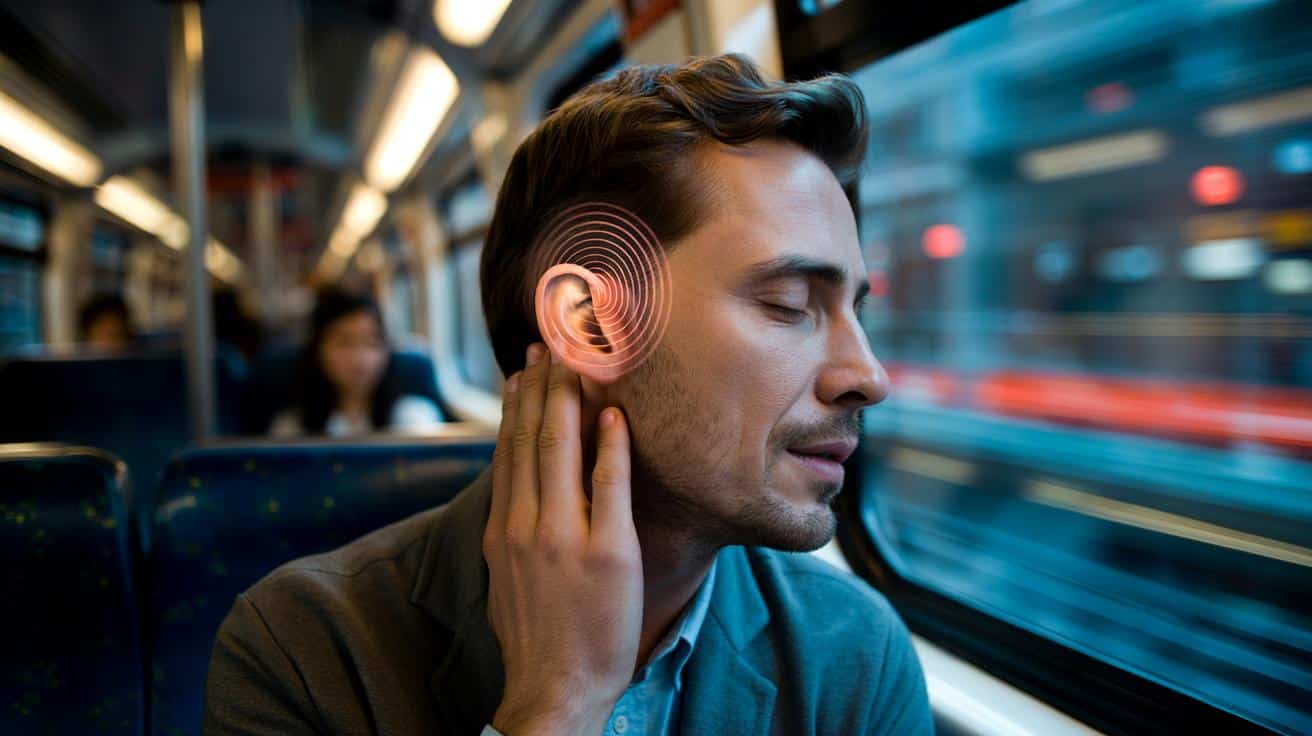
A hiss that rises at night, a ping after a loud café, a buzz that hides beneath traffic. Researchers are finding that this isn’t just an “ear thing”. It’s bound up with a crucial bodily function: the way your body manages blood flow and arousal. Which means the noise might be as much about your heartbeat and breath as your hearing.
On a late train out of London, a man rubbed the side of his neck and closed his eyes. The carriage hummed; his ears hummed louder. He drew a slow breath through his nose, exhaled longer, and the pitch softened a shade. Across the aisle, a teenager tapped a foot to silent music, unaware of the quiet battle happening two seats away.
Some nights, the quiet is louder than the storm. I’ve seen people tilt their heads, shift their jaws, hold their breath for three seconds and swear the ring bends. It’s not magic. It’s the body talking to itself. What if the ring is a pulse?
The hidden link: tinnitus, circulation and your body’s “gain control”
Ask people with tinnitus what changes it and you hear the same odd list: clench the jaw, the sound flickers; turn the neck, it brightens; after a hard run, it spikes then settles. These aren’t tricks of the mind. The ear is fed by tiny blood vessels and wired into the same autonomic network that regulates heart rate, breathing and blood pressure. When that system runs hot, the brain can nudge auditory circuits into “high gain”, amplifying faint internal noise. **Tinnitus isn’t only a story about damaged hair cells. It’s a story about the body’s control of flow.**
Large population surveys have linked tinnitus with hypertension, diabetes and poor sleep. In clinics, many people show lower heart-rate variability—a sign their “rest-and-digest” system isn’t taking the lead as often as it could. One runner told me their tone flares after sprints and settles with slow, nasal breathing in the cool-down. Another noticed the buzz syncing to a gentle throb after coffee and a stressful call with their boss. We’ve all had that moment where stress, posture and breath seem to gang up on a sensation we’d rather not hear.
Here’s the wiring diagram in plain English. Your cochlea needs steady oxygen; tiny dips in blood flow can change how nerve fibres fire. The neck and jaw share pathways with the ear, so tense muscles can nudge those circuits. Then the brain’s attention system—built to prioritise threat—starts tracking the sound, like a searchlight catching dust. The more the autonomic system leans into alert mode, the more the brain boosts internal signals. Not everyone’s noise follows this arc. Still, the pattern is common enough to treat the body-wide link as a real lever.
Small, precise moves that calm the signal
Try this two-minute drill. Sit, close your mouth, rest your tongue on the roof of your mouth. Inhale through your nose for four, exhale for six. Aim for six slow breaths per minute. Keep your shoulders heavy and your jaw loose. After eight to ten breaths, pause and listen—not hunting for silence, just noticing if the edge of the sound feels less sharp or less “forward”. Then add one neck micro-move: turn your head five degrees left, five degrees right, as if saying the tiniest “no”. Breathe again. Repeat once later today.
Common mistakes? Chasing silence with blasting maskers until the ears feel raw. Skipping water all afternoon, then wondering why the head rings in bed. Clenching the jaw during work calls. Going from glassy silence to a packed pub with no ramp-up. **Let’s be honest: nobody actually does that every day.** Life is messy. Aim for gentle consistency instead: small breathing bouts, softer posture, light sound in quiet rooms. Keep the mouth closed when you can; nasal breathing tends to favour a calmer nervous system and a steadier pulse.
Think of this as a dial, not a switch. A calmer body often means a kinder ring, even if the volume doesn’t vanish. Adjust what you can control: breath, neck, sound, routine. Then let the rest be noise.
“When I slow my breath and soften my jaw, the ring doesn’t disappear. It steps back. That’s enough to get on with my day.”
- 60 seconds of 4–6 breathing before sleep and after waking.
- Light neck and jaw relaxation: small circles, placed tongue, unclenched molars.
- Sound enrichment: a fan, brown noise or rain at low volume in quiet rooms.
- Track your ring against sleep, caffeine, stress and exercise for two weeks.
- If your tinnitus thumps with your heartbeat or arrives suddenly in one ear, book a GP check.
A wider way to hear what your body is saying
Once you see tinnitus as the sound of a system, you stop treating it like a moral failing or a static defect. It’s a moving target tied to blood flow, arousal, posture, even how you chew. You can learn its weather. On rough days, you lower the sails: slower breath, softer light, a short walk, a glass of water, background sound. On clearer days, you live. **Tinnitus becomes one sensation in a crowd, not the headline act.**
This doesn’t erase trauma, hearing loss or the thrum of a city. It nudges the whole mix toward ease. People report that when sleep stabilises, the noise feels less personal. When stress has somewhere to go—through breath, movement, conversation—the brain gives up some of its grip. No one fix suits everyone. Yet a body-first approach creates more doors to try. It’s not about perfection. It’s about changing the conditions the sound lives in.
| Point clé | Détail | Intérêt pour le lecteur |
|---|---|---|
| Blood flow and autonomic link | Tinnitus often tracks heart-rate variability, blood pressure and arousal | Explains day-to-day swings and where to act |
| Somatic crossover | Jaw and neck inputs can modulate auditory circuits | Simple posture and relaxation drills can help |
| Habit levers | Breathing pace, sleep routine, sound enrichment | Low-risk tools to ease distress and reactivity |
FAQ :
- What is the “crucial bodily function” linked to tinnitus?The body’s regulation of blood flow and arousal—your autonomic nervous system—appears closely tied to how loud and intrusive tinnitus feels.
- Can breathing exercises really change the sound?They can change your nervous system state, which often softens the brain’s gain on internal noise. The tone may not vanish, yet the edge can ease.
- Is tinnitus a sign of high blood pressure?Not automatically. Large surveys show they often coexist. If your tinnitus is new, pulsatile or one-sided, see your GP for a proper check.
- What about jaw and neck tension?These areas share pathways with auditory circuits. Gentle mobility and relaxed jaw posture can reduce reactivity for many people.
- Will this go away on its own?Sometimes it fades. Often it changes shape as you change your habits and stress load. Aim for progress, not silence.







Fascinating read! I’d never connected my tinnitus to circulation and arousal before. The micro-moves and nasal breathing cues feel doable—saving this for my nightly wind-down.
Interesting, but correlation isn’t causation. Large surveys linking tinnitus with hypertension or diabetes don’t prove the autonomic system is driving the noise. Did the reserchers control for age, noise exposure, ototoxins, and anxiety? Any randomized trials showing HRV-focused breathing reduces tinnitus loudness versus sham? Without robust statitics and longitudinal data, this reads more like a plausible mechanism than evidence.