
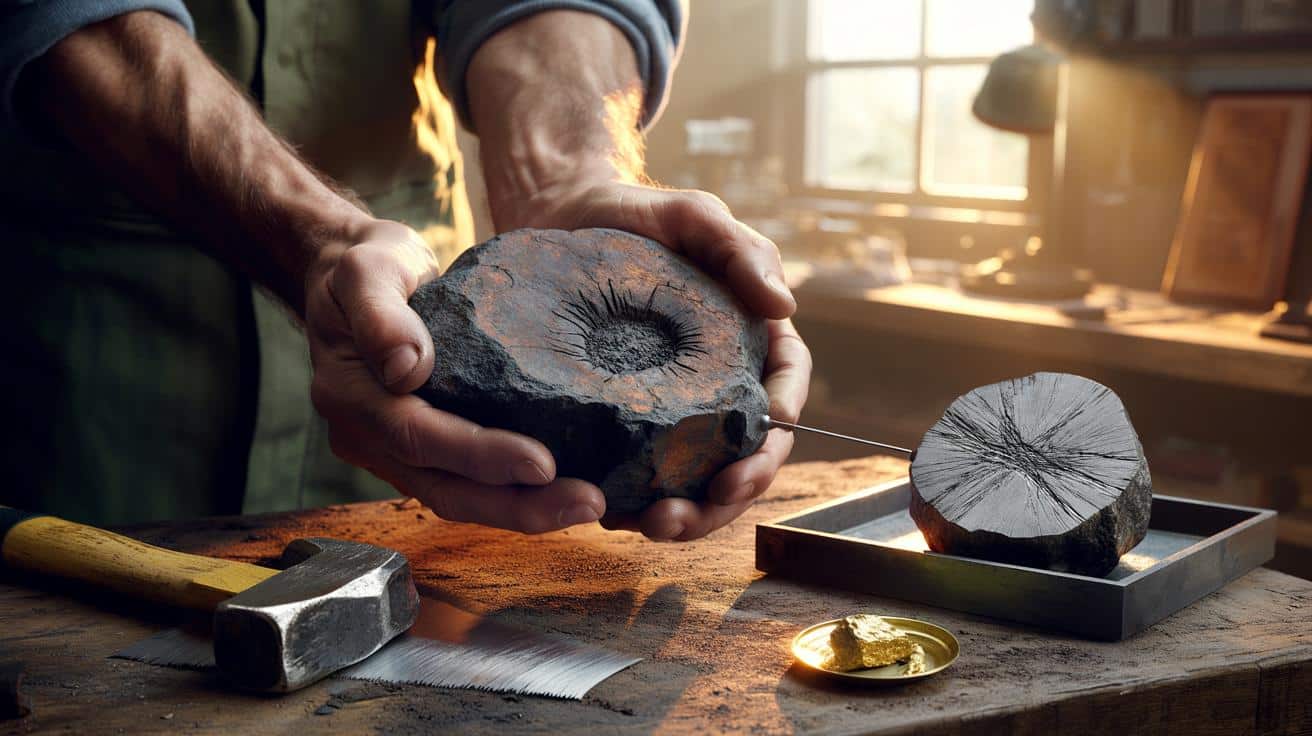
He tucked a heavy, rust-red rock on a shelf and called it “the gold maybe.” Years later, a geologist would tell him it wasn’t gold at all — and that was the best news of his life.
He turned the rock in his hands the way you turn a secret, weighing the thought of luck against the fact of its heft. We’ve all had that moment when a hunch clings harder than the dirt under your nails.
He’d found it in shallow ground after rain, the soil crust flaking off like burnt sugar, the nugget-dream lighting up the back of his mind. He tried to crack it with a hammer and got nowhere. *It felt wrong to throw it away.*
What if the dull thing in your garage isn’t dull at all?
The rock that wouldn’t give up its story
In his case, the rock fought every tool. Hacksaw, grinder, even a drill bit that squealed and skittered as if the stone were made of iron will rather than iron ore. The more he tried, the more the thing seemed to insist on being left whole. **Gold glitters; meteorites don’t.**
Years went by. It sat on the shelf like a paperweight for a life he hadn’t quite lived, too heavy to move, too hopeful to bin. The day he finally carried it to a museum, he did it like you take an old ache to a doctor: half expecting an eye-roll, half ready for a miracle.
The result flipped the room. Not a nugget. A meteorite: a lump of space, older than our planet’s topsoil, forged in fire and flight, rich in nickel-iron and tiny patterns that only show when an expert reveals them. More valuable not because it would pay off a mortgage, but because it could tell a story only the cosmos knows.
Why this “not-gold” is the better find
The truth is, most backyard “gold” lacks the weight, the drag, the stubbornness. Real nugget gold dents. Meteorites don’t. They tug at a magnet, hide scuffed fusion crusts, and carry a quiet density that surprises your wrist. Rarity comes next. Nuggets are rare. Fresh meteorites are rarer.
There’s a stat that brings it down to earth. Of the countless shooting stars we see each year, only a few hundred meteorites are verified on the ground globally, and only a slice of those are new to science. Some hold minerals never seen on Earth, formed under pressures no mine can mimic. That’s not “bling”; that’s a chapter of solar system history sitting in your boot tray.
The money side? It varies wildly. A small, common chondrite might sell for less than a flashy nugget, while a rare type — carbonaceous, lunar, Martian — can command numbers that make jewellers blink. Value is a sliding scale: science at the top, story in the middle, market at the bottom.
How to tell if your “gold” might be a meteorite
Start with three simple checks. Lift it: does it feel oddly heavy for its size? Touch it with a magnet: does it pull, even faintly? Look close: is there a thin, dark “skin” over a metal-speckled interior when chipped? **Let the magnet be your first test.**
Common mistakes trip everyone. The classic mix-up is with ironstone or slag — industrial leftovers that play dress-up as space rocks. Slag often has bubbles; meteorites rarely do. Gold stays soft and buttery when scraped. Space metal fights back. Let’s be honest: nobody really does that every day.
When the clues stack, take it to a lab or museum. They’ll check for nickel with a quick test, and if it’s promising, cut a thin slice to reveal the Widmanstätten patterns — those icy, cross-hatched lines you only get from very slow cooling in asteroids.
“The day a meteorite walks through the door is the day we all turn into children again,” a curator told me, smiling like he’d heard the universe knock.
- Use a strong fridge magnet, not a weak souvenir.
- Check for a fusion crust: thin, dark, and matte, not glassy.
- Look for metal flecks inside, not just on the surface.
- Avoid vinegar or bleach tests; they ruin samples.
- Photograph it next to a ruler in daylight before transport.
Bigger than gold: what this really means
There’s a quiet thrill in knowing your rock is a visitor, not a native. It means your find can help date ancient collisions, map the chemistry of early planets, and refine models of how worlds form. A good specimen might anchor a student’s thesis or fill a gap in a national collection. **Rarity beats bling.**
For the man who kept the rock for years, the pay-off wasn’t a cheque. It was a sudden sense of scale. Your shed, the stars, the long silence between — all connected by a dented lump that fell through our atmosphere and landed within reach of your muddy boots.
We chase gold because it’s easy to recognise. Space rocks ask us to look twice. The difference is the sort of value that lingers long after the shine fades.
| Point clé | Détail | Intérêt pour le lecteur |
|---|---|---|
| Simple tests | Weight, magnet pull, fusion crust | Quick way to sort likely meteorites from lookalikes |
| Rarity factor | Only a few hundred confirmed finds each year | Explains why science prizes them over gold |
| Next steps | Museum visit, nickel test, expert cut | Protects value and maximises the story your rock can tell |
FAQ :
- How can I tell if my rock is gold or a meteorite?Gold is soft, non-magnetic, and bright when scratched. Most meteorites are magnetic, very hard, and often show a thin dark crust.
- Is a meteorite always worth more than gold?Not always in cash terms. Scientifically, many meteorites are “worth” more because they are rarer and carry data about the early solar system.
- Can I cut the rock myself to check?You can try, but you risk destroying features. A museum or university can make a scientific cut that preserves structure.
- Will a magnet test ruin my rock?No. A simple magnet check is safe. Just avoid scratching or using harsh chemicals that can damage the surface.
- Where should I take a suspected meteorite in the UK?Contact a local university geology department or a major museum like the Natural History Museum in London for guidance.







Love this—rarity beats bling. The image of a “lump of space” on a dusty shelf is going to live rent‑free in my head.
Pics or it didn’t happn—could be slag, right?