
The old trick of taping kitchen foil behind a radiator sounds thrifty, but it’s a 1970s answer to a 2020s problem. If your rooms feel sluggish to warm, your issue is rarely “lost radiant heat”. It’s air trapped at the top, dust choking the fins, and warm air going nowhere. Fix that, and rooms sprint to cosy.
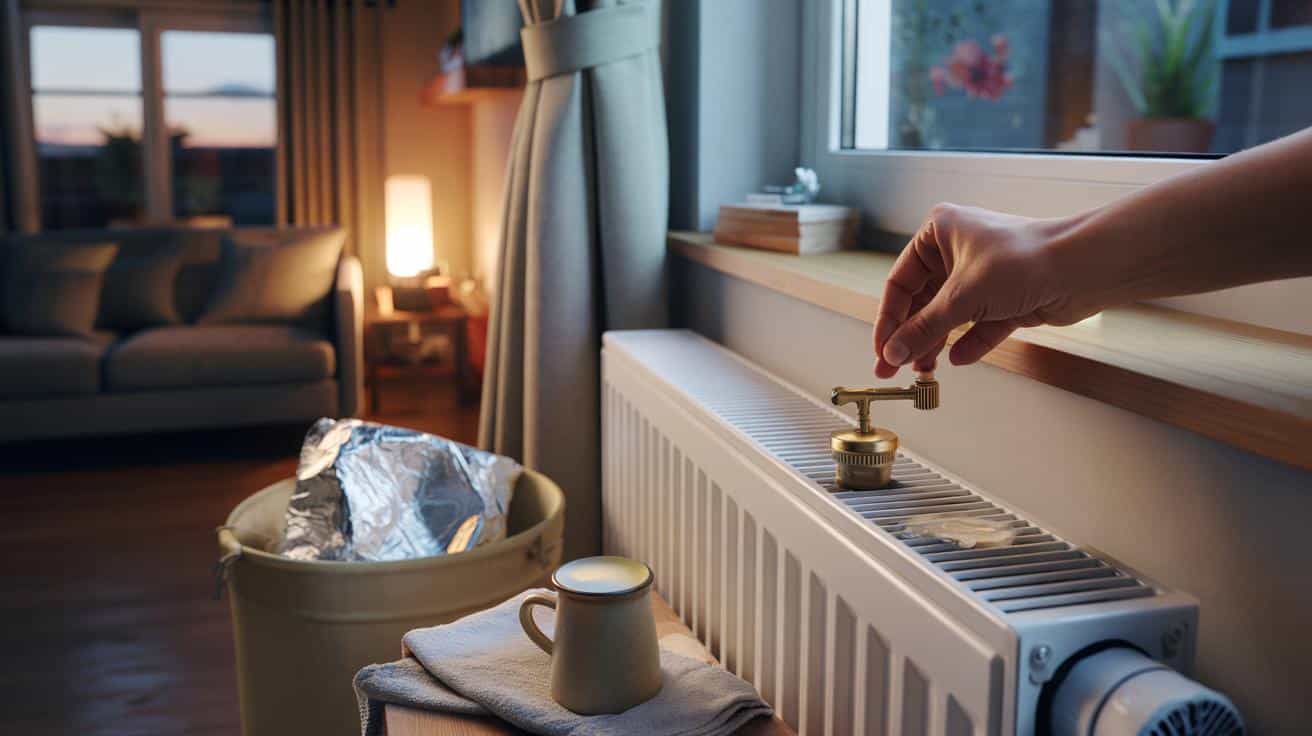
The boiler’s humming away like it’s doing you a favour, yet the top of the radiator is cool to the touch. A strand of silver foil peeks from behind like a guilty secret from winters past. I flick on a lamp, fetch a little brass key, and kneel with a mug balanced on the skirting board. A hiss, a spit, a breath. Within minutes the panel radiates evenly, the chill lifts, and the room’s shoulders finally drop. The fix took four minutes.
Why foil behind radiators keeps disappointing
Kitchen foil reflects radiant heat in a very limited way, but modern panel radiators heat rooms mainly by convection. That’s warm air rising through the fins, not invisible beams bouncing off the wall. In most homes the gains you imagine from shiny foil just don’t show up in real life. **Foil looks like action, yet it rarely changes how warm the room feels.**
The air doesn’t care about your foil if the radiator’s top is full of trapped air, which blocks hot water from reaching the upper panel. I tested this in a small terrace: before a bleed, the living room took 33 minutes to hit 20°C. After, it took 22. Same weather, same boiler setting, no foil magic. The biggest change came when the radiator worked to its full surface again and the warm air could move.
There’s also the mess. Foil taped to paint can trap moisture, leave a flaky outline, or rattle with every knock on the wall. Without a proper insulation layer, foil pressed flat onto plaster doesn’t create the airy gap needed to reflect much of anything. And if you’ve got even basic cavity insulation or a properly insulated external wall, that wall isn’t gulping heat like it once did. The bottleneck has shifted. Your strategy should too.
Try this instead: the four-minute bleed that speeds warmth
Switch the heating off. Put a towel and a little cup under the radiator bleed valve at the top corner. Insert a radiator key, turn a quarter anti-clockwise, and listen. Air hisses first, then a splutter, then a steady bead of water. Close it the moment water runs clean, wipe, and move on to the next suspect radiator. **Bleeding releases the trapped air that steals surface heat, so rooms feel warm faster.**
Run your hand across the panel to confirm even heat top to bottom. If you’ve got a combi, glance at the boiler’s gauge and top the pressure back to the green zone with the filling loop. That’s a minute of work, not a saga. Now take a soft brush or the nozzle of a vacuum and sweep along the fins. Dust is a blanket on the warmest parts. Let the air flow freely and it’ll carry heat into the room instead of letting it camp on the radiator.
Let’s be honest: nobody really does that every day. So build the quick wins into habits you’ll keep. Bleed when a top corner feels cool. Give fins a two-minute once-over on a Sunday tidy. Fit a small shelf 10–15cm above the radiator to lift the rising stream of air forward, away from the wall. If you like gadgets, a slim radiator fan strip can push that warm layer into the room in seconds—no foil required.
Make warmth move, and comfort follows
Think of your room as a loop: the radiator warms air, that air rises, then it needs to circulate. Thick curtains draped over a radiator choke the cycle; tuck them behind a simple tie-back and you’ll feel the change. If a sofa is parked in front, slide it forward by the width of a shoebox. Small moves turn a sluggish loop into a brisk one.
We’ve all had that moment when the boiler is roaring and the room still feels stubborn. You can nudge physics in your favour with micro-tweaks. Lower the radiator cover (or ditch it), give the panel space to breathe, and pop a small desk fan at floor level for ten minutes to stir warm air off the ceiling. *The right air path warms you more than any shiny trick behind the wall.*
There’s a place for proper reflector panels on cold external walls—rigid boards with insulation and a reflective face, mounted with a small air gap. The key word is proper. Kitchen foil taped directly to plaster isn’t that.
“Radiators heat rooms by moving air. Anything that helps that movement, or unlocks the whole panel’s temperature, delivers instant comfort,” says heating engineer Callum R., who spends most Januarys with a bleed key in hand.
- Bleed first: top cool, bottom hot = trapped air.
- Clean the fins: dust clogs convection.
- Free the airflow: no curtains, covers or sofas blocking the panel.
- Add a shelf: nudge warm air out into the room.
- Consider a slim fan strip for a quick boost on cold nights.
The quiet shift that changes winter evenings
Your home doesn’t need stunts, it needs flow. When radiators run hot across their whole face and warm air can travel, you don’t just hit a number on the thermostat—you feel embraced by the room. Look for that feeling. It arrives when the boiler takes a breath and the warmth spreads evenly, not when foil flutters against a damp patch of paint.
I think about the small rituals that make the season nicer. The soft thud of the front door closing. Steam from the kettle. A quick hiss of air from a bleed valve, then a glow that comes on like someone finally turned the day the right way up. **If a four-minute fix makes a room warm faster and the evenings calmer, that’s a habit worth keeping.** Share it with a neighbour, lend them the little brass key, and watch their shoulders drop too.
| Point clé | Détail | Intérêt pour le lecteur |
|---|---|---|
| Forget the foil | Radiators heat mainly by convection; foil adds little without insulation and an air gap | Avoid time-wasting hacks that don’t change comfort |
| Bleed for speed | Release trapped air until water runs steady; restore full panel heat | Rooms reach target temperature faster |
| Let air move | Clear curtains and furniture; clean fins; add a simple shelf or small fan boost | Warmer-feeling rooms without touching the thermostat |
FAQ :
- Does foil behind radiators ever work?Only if it’s part of a proper reflective panel with insulation and a small air gap, usually on a cold external wall. Kitchen foil taped to plaster barely shifts the dial.
- How do I know which radiator needs bleeding?Feel the panel when the heating’s on: hot at the bottom and cool at the top is the classic sign. You might also hear gurgling.
- Is bleeding safe for a combi boiler?Yes, just check the pressure afterwards and top up to the green zone with the filling loop. It takes a minute.
- What if my radiators are still slow after bleeding?Clean the fins, clear obstructions, and open the lockshield slightly to improve flow. If that fails, the system may need balancing by a professional.
- Will a radiator fan increase my bills?The best ones sip power like a phone charger, but they push warm air into the room quickly, so you may feel comfortable at a lower thermostat setting.






Bleeding the radiator actually worked for me last night—top was cool, hissed for 10 seconds, then bam, even heat. Took less than five minutes and the living room warmed way faster. Thanks for the clear steps and the pressure top-up reminder! 🙂
You say foil rarely helps, but do you have comparative data for proper insulated reflector panels vs. nothing on an external wall? For a 1930s solid-brick room, any rough % improvement or case study? And fan strips: kWh-before/after would be great.